
By Andrew Israel kazibwe
From 2nd to 30th March 2023, MADS Kigali gallery played host fine art photographer Funmilayo Kayode’s solo exhibition titled Èkó Akété: Fragments of a Living City. The exhibition was a powerful and deeply moving reflection on Lagos, a city that is as much a myth as it is a bustling reality. This body of work brought together a series of photographs that look at the modern African megacity through its architecture, busy markets, public monuments, and the beautiful chaos of everyday life.
The title itself is a nod to an old Yorùbá praise name for Lagos, with Èkó Akété being more than a spot on a map but a calling. Kayode successfully avoids the easy trap of flattening Lagos into just a wild spectacle or a place of pure chaos. Instead, she shows us a living organism that is constantly bargaining between survival and ambition, ruin and rebirth.
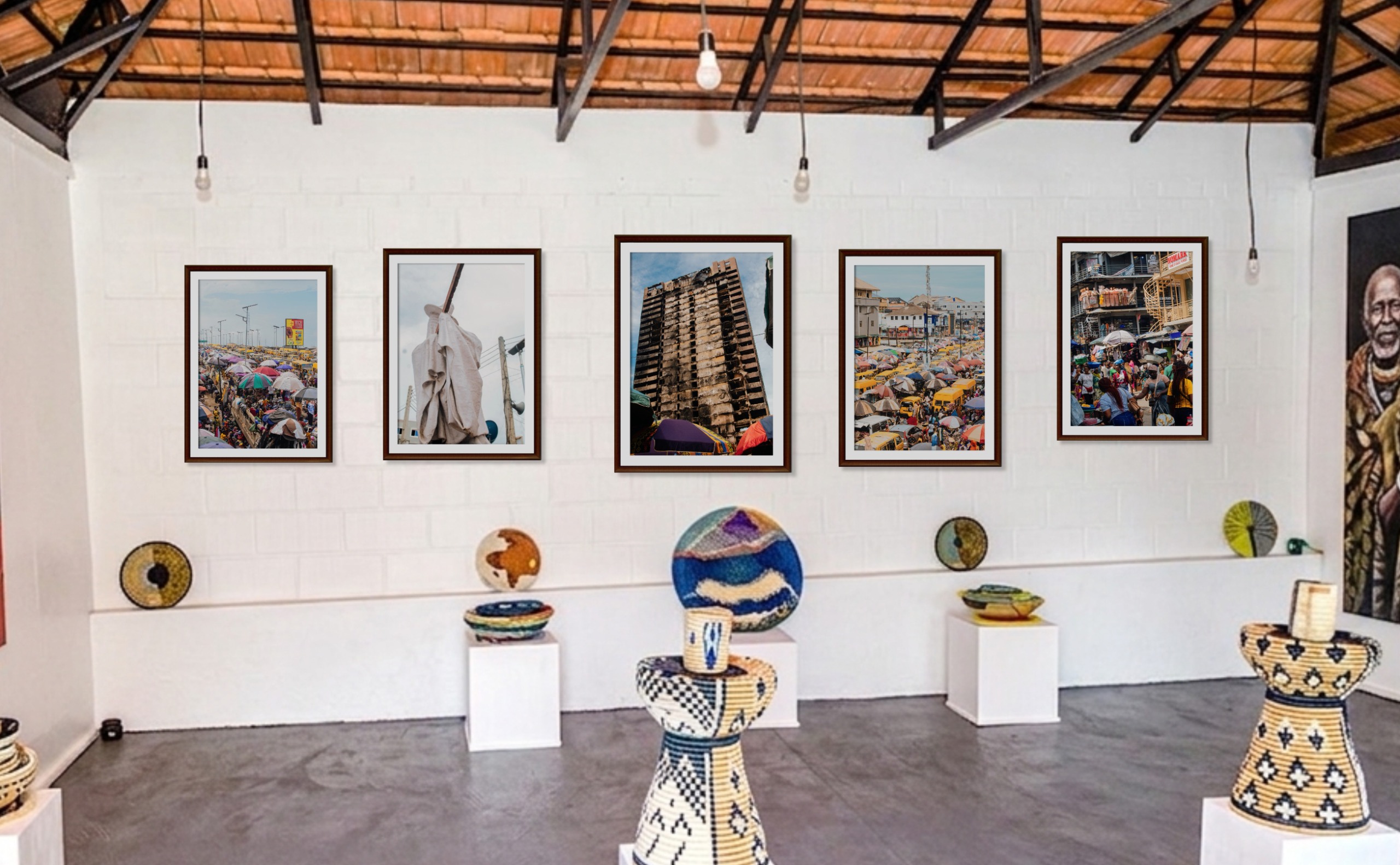
The way the gallery is set up plays a huge role in how we take in the story. Across the walls, Kayode’s framed photographs are given plenty of space to breathe. Placing them inside a clean, quiet architectural interior, surrounded by neat sculptures and handmade crafts, creates an interesting tug-of-war between the suffocating density of Lagos and the eerie silence of the gallery. This contrast does wonders for the photos. The city’s noise, bright colours, heat, and traffic don't drown you out; they are neatly captured and held within the borders of the frame.
The most striking image in the collection is easily the photograph of a fire-damaged high-rise building, positioned right near the centre of the gallery space. Its charred, dark surface cuts right through the brightness of the nearby market scenes, bringing a sudden, necessary heaviness to the exhibition. Here, Kayode captures a Lagos that is just as fragile as it is fast-growing. The building stands like a wounded soldier, a vertical monument to neglect, disaster, and untold urban history.
Refreshingly, Kayode does not get sentimental here. The building simply becomes a powerful sculptural presence, a reminder of the messy aftermath that often gets ignored in glossy stories about African urban growth.
Around this dark centrepiece, Kayode’s market scenes bring a completely different energy. Bright yellow danfo buses, market umbrellas, pedestrians, and tight alleyways form a thick tapestry of colour and life. Yet, these are not just chaotic snapshots. The magic lies in Kayode’s ability to turn a traffic jam into a painting. Market umbrellas become deliberate pops of colour; buses become rhythmic patterns of city life; and the crowds become a beautifully choreographed dance of honest, daily hustle. Lagos comes alive as a city held together not just by roads, but by pure improvisation.
This sense of control is where Kayode truly shines. Her photos are visually rich without making your eyes hurt. She uses colour to build structure, not just to look pretty. The signature yellow of the buses, the pale blues of the sky, the weathered concrete of old blocks, and the scattered umbrellas create an internal visual language. Your eyes don't wander randomly; they follow a carefully planned path through the layers of the image. This is fine art photography at its best: the city isn't just documented, it is reimagined.
Kayode’s Lagos is also a place full of symbols. By capturing public art, old statues, and culturally heavy landmarks, she takes us beyond the basic machinery of buying, selling, and commuting. These images hint that the city is shaped by beliefs, memories, and shared dreams just as much as it is by economics. In a way, Èkó Akété is less about documenting what Lagos looks like and more about asking how Lagos feels, how it shows off, and how it remembers its past.
Naturally, the collection invites comparisons to photography greats. It brings to mind Akinbode Akinbiyi, who spent decades wandering African streets to capture the quiet poetry of the pavement.
Like Akinbiyi, Kayode knows the city is understood by looking at the small things over time rather than chasing a single, shocking view. However, her style is much more direct, structured, and driven by bold colours. Where Akinbiyi finds meaning in quiet observation, Kayode builds it through tight framing and sharp contrasts.
There are also hints of Andrew Esiebo’s work, known for tracking Nigerian life, changing architectures, and social shifts. Both photographers view the city as a stage where identities are constantly morphing. Yet, Kayode takes a more meditative approach. Her Lagos isn't just a social space; it feels almost spiritual, suggesting that old buildings and crowded markets are physical containers for the souls and memories of those who passed through them.
The ruined buildings and public spaces also echo Guy Tillim’s famous coverage of post-colonial African landscapes and the political scars left on city walls. But while Tillim often looks at things from a detached, clinical distance, Kayode keeps things warm and close. Her camera doesn't judge Lagos from afar—it moves with the crowd, feeling its textures, its loud noises, its weaknesses, and its incredible knack for reinventing itself.
You could even tie her sensibility to Santu Mofokeng’s legendary eye for landscape and spiritual atmosphere. Though Kayode captures concrete instead of the countryside, she shares Mofokeng’s obsession with the invisible forces hiding in plain sight. In her hands, Lagos becomes an emotional terrain where history is constantly bumping into the present.
What makes Èkó Akété: Fragments of a Living City stand out so clearly is its refusal to tell a simple, one-sided story. Lagos isn't painted as a triumphant success, a broken slum, a nostalgic memory, or a futuristic dream. It is all of those things wrapped into one. By focusing on "fragments," Kayode holds onto these contradictions without trying to force an easy answer. Each photo gives you a piece of the puzzle, and the incompleteness is exactly what makes it work. The viewer is forced to build the city in their own mind, moving from one image to the next much like you would navigate Lagos itself: through sudden stops, crowds, surprises, and self-discovery.
The title gets it exactly right. These are fragments, but they aren't sad pieces of something lost. They are fragments of survival, beauty, and continuity. Kayode shows us a city that builds itself up and tears itself down every single day, where a burnt skyscraper can sit peacefully next to a roaring market, and where the past refused to be buried by the present.
If there is any room for critique, it is that the visual flow could have been pushed even further. The connection between market life, ruined buildings, and public art is already brilliant, but a tighter curatorial hand could have sharpened the emotional journey through the gallery. Moving deliberately from chaos to a sudden break, then to a symbol, and finally to rebirth would have made the exhibition's core message hit even harder. Still, this is a minor note on an otherwise stellar show that speaks to the sheer depth of Kayode’s archive.
Ultimately, Èkó Akété succeeds because it treats Lagos as both a real place and a metaphor. Kayode’s images are firmly rooted in the gritty, recognizable textures of the city, yet they open the door to massive questions about who we are, how we remember, and the human will to keep pushing forward in an unpredictable world. Her Lagos is not static. It breathes, it breaks, it rebuilds, and it dreams.
In this exhibition, Funmilayo Kayode gives us a deeply thoughtful study of a city in a non-stop argument with itself. The show confirms her position as an artist who doesn't just look at the surface of a place, but understands the real forces that keep its heart beating: hard work, faith, tragedy, beauty, and resilience. Lagos doesn't just serve as a backdrop here but takes center stage as the main character.
